
A Management Buyout, or MBO, is a special type of business transaction in which the existing management team of a business purchases a controlling stake in (or buys out) the company, thereby becoming owner-managers of the business.
This could be taking control of the company from retiring founders, a parent company, or external shareholders. What makes this transaction unique is the fact that the buyout is initiated by internal managers, not external investors.
MBO: The Key Features
- The management team assumes ownership of the business, in addition to operational control.
- It is often financed through a mix of personal funds, bank loans, private equity and other funding sources.
- It is a popular choice when owners are retiring, divesting or refocusing on other areas, while the management team has a strong, long-term plan for business growth.
- The MBO route is ideal for retiring founders/owners without a clear successor and ensures continuity by keeping experienced leadership in place.
For the right business and management team, a Management Buyout is an excellent opportunity for the exiting owner, the internal management team, and the business itself.
In this guide, we’ll take you through everything you need to know, from planning right through to execution and the future of the business.
Management Buyout Legal Structure
A Management Buyout must be carefully structured for regulatory compliance, risk management, and to ensure both the buyers and sellers have their intentions reflected accurately.
The legal framework used will depend on the business characteristics, the complexity of the deal and whether external financing is involved (which it usually is).
Share purchase (most common)
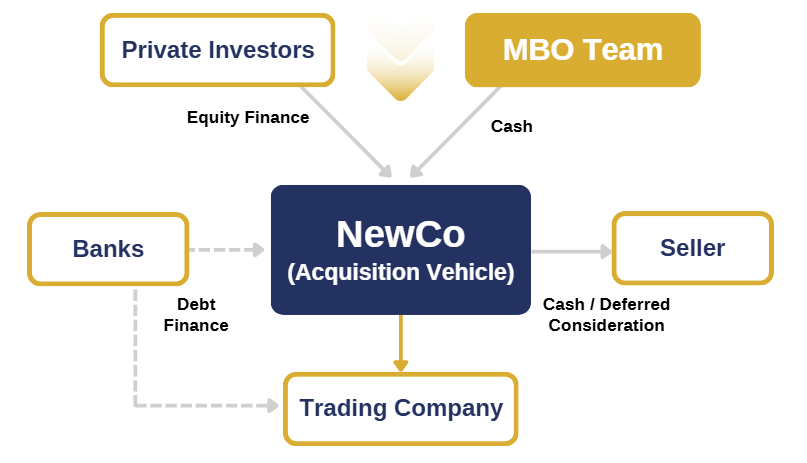
In a typical share purchase structure:
- Private investors provide equity finance to NewCo (the acquisition vehicle), and the MBO team invests cash.
- Banks provide debt finance to NewCo.
- NewCo pays the seller in cash and/or deferred consideration, and acquires the trading company.
Key points:
- The management team set up “NewCo”, which acquires the shares of the target company.
- Ownership and liabilities are transferred to NewCo.
- NewCo may raise debt and use it to acquire the target company with the backing of banks or private equity organisations.
Asset purchase
In this case, only specific assets, such as contracts, P&M (plant and machinery) or goodwill, are acquired by the MBO team. This is a less common structure that is typically used when buyers want to avoid liability and ring-fence risk.
When to consider a Management Buyout
Like all types of business transaction, the suitability of a Management Buyout depends upon the business and those involved in its ownership and management.
This is not an exhaustive list, but the following are some scenarios that make an MBO particularly attractive due to its insider advantage, continuity of leadership and reduced risk for lenders and investors.
What are the ideal scenarios for a Management Buyout?
A Management Buyout is ideal in several situations, and it is certainly not a restrictive route. Some scenarios, however, are particularly well suited.
- The owner wants to retire or exit: If a business owner or founder wants to retire or exit the business but has no suitable family successor or external buyer lined up, a Management Buyout provides business continuity and preserves their legacy and cultural values. These can often be lost through a trade sale.
- Corporate divestiture: An MBO is a suitable route if a parent company decides it wants to divest a non-core or underperforming division of its group, but the division’s management team believes in its potential and wants to own and run it independently.
- Private companies with loyal and experienced management: If yours is a long-standing, stable business with a trusted and experienced management team, it could be an ideal MBO candidate. It is particularly worthwhile if management has a long-term vision for the business.
- Discretion and sensitive industries: If the seller wants to avoid the publicity and due diligence complexities associated with trade sales, an MBO is a much more discreet transaction. This makes it especially suitable for industries, like healthcare or law, where continuity and confidentiality are critical.
- Lower risk for lenders and investors: Thanks to the management team’s insider knowledge, improved business continuity, and a proven track record of success, banks and private equity firms may be more willing to finance MBOs, especially when the business is stable and profitable.
The Pros and Cons of a Management Buyout
An MBO is an attractive option for the right businesses and prospective owners, especially if a capable and experienced management team is involved. However, like all transaction types, there are pros and cons to a Management Buyout. Below is a summary of these.
Understanding these advantages and potential risks is essential for both current owners and management teams considering this route.
The Management Buyout Process
Management Buyout Feasibility Planning
The first, and perhaps most important, step of an MBO is the initial feasibility and planning phase. It is critical that you understand whether an MBO is realistic and financially viable before proceeding.
This includes laying the groundwork for how it is structured, understanding how to secure support, and identifying points of potential risk.
- Assess the readiness of the management team, including their leadership capability, their motivation and commitment, and access to funding.
- Evaluate how suitable the business is for an MBO. Is it profitable and capable of servicing acquisition debt? Are revenues and operations stable enough for a leveraged buyout, and is there a clear path to value post-deal?
- Is the owner willing to sell to internal management, and will they consider flexible repayment terms?
- Seek an accurate, independent business valuation to help assess affordability and funding requirements.
- Engage early with banks, private equity firms, or other funding options, and make sure there are routes to finance the MBO under the current conditions.
- Figure out if there are any legal or regulatory obstacles in the way, and factor these (if necessary) into the structure of the transaction.
- Maintain confidentiality and keep things internal to avoid disruption or information leakage.
- Start thinking about how and when to communicate with employees, stakeholders, or shareholders if the deal proceeds.
When thinking about a Management Buyout, it is essential to get support from external advisors with experience in this specific type of transaction. This includes corporate finance specialists, solicitors and accountants.
Forming the Ownership Team
Another critical aspect of a successful Management Buyout is assembling the right leadership team to take over. They must be credible, experienced and capable, with aligned goals for the future of the business. The team must:
- Have proven leadership skills, operational expertise and a strategic vision for the business. Common roles include CEO/Managing Director, Finance Director, and Heads of key departments.
- Have defined roles and responsibilities, including who will lead the deal itself, and what the team structure will be post-transaction.
- Have aligned interests, commitment to the buyout goals, and a willingness to invest personal capital and accept the associated risks.
- Address any skills gaps, such as legal or tax. They may opt to fill these gaps with external advisors or future hires after the MBO.
- Maintain confidentiality and limit the MBO team to a small, trusted group.
- Plan for share allocation and have a clear ownership structure in mind, particularly the division of equity.
Getting a Business Valuation
For an MBO to go ahead, the business will need an accurate and defensible business valuation. This forms the basis for pricing the deal, securing finance and negotiating terms between both parties.
The valuation must balance the seller’s expectations with the management team’s ability to fund the deal. A credible valuation requires detailed financial records and industry benchmarks. This will ensure that the buyout is fair and financially sustainable.
Securing Funding for a Management Buyout
Financing a Management Buyout can be a little complex depending upon the financial position of the MBO team. They will need to secure sufficient funding to purchase the shares in a way that spreads risk appropriately.
Equity from management
This is often a key component, demonstrating the individuals’ commitment to the project. Given the numbers involved, however, this is usually a minority figure compared to the total capital required. It is important to balance each person’s equity stake with their personal attitude to risk, while still providing a meaningful contribution.
Leveraged buyout (LBO)
When a business is acquired primarily through borrowed funds, with business assets and cash used as collateral, this is known as a leveraged buyout (LBO). This is a common tactic for MBOs because it enables buyers with limited up-front cash to gain ownership, but it does come with increased financial risk.
Private equity
A private equity firm may sometimes play a major role, providing funding in exchange for an ownership stake in the business.
Debt financing
One of the most common methods of financing an MBO, debt finance can include secured loans, asset-based lending, or vendor financing (deferred consideration, in which payments are made to the exiting owner gradually over time).
It is essential that the MBO team assesses their debt capacity and repayment ability carefully. This includes ensuring the business can generate sufficient cash flow to service acquisition debt, particularly during periods of downturn.
The government-owned British Business Bank also supports a range of finance options for smaller UK businesses.
Negotiating with the Current Owners
While a Management Buyout is advantageous because the MBO team are negotiating with someone they typically have a long-term, positive relationship with, it is still important to negotiate terms that work for everyone.
This ultimately means finding the ideal commercial terms for all parties, while maintaining trust, confidentiality and professionalism.
Step 1: Establish mutual intent
Ideally, this should be done as early as possible. The MBO team will need to confirm the owner’s openness to an MBO, and understand their goals, timeline and pricing expectations.
Step 2: Maintain transparency and trust
To ensure a smooth and positive process, it is really important to keep communications open and respectful, especially when disagreements arise. It is critical that the individuals involved do not act in self-interest; conflicts of interest can do real damage to the credibility of the MBO.
Step 3: Agree a valuation framework
The MBO team will need to provide a realistic and defensible (evidence-based) valuation to base the deal around. This is not something that should be done by the MBO team themselves, even if they have experience in finance. Instead, we strongly recommend seeking an independent, third-party valuation from a reputable source. This will help avoid bias and ensure fairness.
Step 4: Agree a fair deal structure
This is where you will determine how the deal will ultimately take shape, and may include factors like deferred payments and vendor financing. It may also include terms relating to earn-outs based on future business performance. Depending on the wishes of the exiting owner, a phased transition period may also be included to ease their exit.
Step 5: Legal and operational terms
A potentially complicated, but equally essential, phase of the negotiations is the legal and operational aspects of the deal. Ownership transfer mechanics will need to be determined (i.e. shares versus assets). You will also need to include any warranties, indemnities or non-compete clauses as applicable.
Finally, if the owner wants to retain some involvement in the business, their post-sale role should also be formally agreed.
Both the MBO team and the current owner should consult expert advisors in legal, tax and corporate finance to ensure the deal is properly structured and documented.
Management Buyout Due Diligence
Due diligence is a critical step of a Management Buyout because it enables both the MBO team (the buyers) and the current owners (the sellers) to assess risk, support their financial or structuring decisions, and ensure an accurate and fair valuation.
For the MBO team (the buyer)
For the buyer, there are several key areas where due diligence is necessary, depending on how involved they already are in day-to-day decision making and processes:
For the owner (the seller)
For the seller, due diligence generally involves ensuring that the business is transaction ready so that the deal goes smoothly and remains confidential.
It is strongly advised that both buyers and sellers seek professional assistance when conducting due diligence. The costs of this can be shared or absorbed, depending on the structure of the deal itself. However, the risk of the deal failing is considerably higher without adequate due diligence taking place.
MBO Legal Documentation
As you might expect, an MBO transaction involves a lot of legal paperwork. Despite its potential complexity and the stress it can cause without proper assistance, getting the legal documents sorted properly is critical for a successful and compliant acquisition.
It is important that you consult a solicitor on these items, but it is also useful to know what will be required before embarking on the MBO project.
Heads of Terms
This is the letter of intent: a non-binding outline of the main deal terms, including the price, structure and timelines involved. This essentially sets the negotiation framework ahead of time.
Share Purchase Agreement (SPA)
This is the legally binding contract that details the terms of sale for the MBO acquisition. It will need to include prices, warranties, indemnities, completion clauses, payment terms and any restrictive covenants.
Disclosure Letter
This sets out any exceptions to the warranties made in the Share Purchase Agreement and is designed to protect the seller by providing pre-disclosure of any existing issues.
Loan Agreements
These documents detail the terms of any financing involved with the acquisition, and include any covenants, security arrangements and repayment terms.
Investment Agreement (if external investors are involved)
This sets out the rights, obligations and ownership of any third-party backers outside of the MBO team, and includes governance, exit strategy and any preference shares (if applicable).
Articles of Association
These will need to be updated to accurately reflect the new ownership and voting structure, and cover things like share transfers and how the board is set up.
Client success story: Evoluted's Management Buyout

Sheffield-based digital agency Evoluted successfully completed a Management Buyout (MBO), enabling Managing Directors Giorgio Cassella and Sam Biggins to take full ownership of the business from its founders.
Gravitate Corporate Finance, led by Martin Dean, supported the management team throughout the transaction, providing expert advice on business valuation, negotiations, heads of terms, deal structure, legal documentation, and the establishment of a new company (NEWCO).
With Gravitate's guidance, the management team navigated the complexities of the buyout, achieving a successful transition with minimal disruption to employees and clients.
Since completing the MBO, Evoluted has strengthened its financial position, reduced unnecessary costs, and identified £20,000 in additional annual revenue. The new owners now have the freedom to pursue their own growth strategy and long-term vision for the business.
"Having the right guidance made all the difference. Martin was invaluable in helping us understand valuation, terms, and negotiation."
Management Buyout FAQs
Why do business owners choose to sell via an MBO?
There are some unique benefits to an MBO from the perspective of the seller. MBOs offer a smooth transition process and can preserve the culture of the company. They are also often faster and significantly more discreet than open market sales. This makes them ideal for succession planning or retirement.
How is a Management Buyout funded?
For a Management Buyout to go ahead, funds will be required that may not be available to the management team. Typical funding sources include management equity (their own funds), bank loans and other types of financing, private equity involvement, and sometimes vendor financing (such as deferred consideration or loans issued by the seller).
What role can private equity firms play in an MBO?
In some cases, private equity firms can provide capital and strategic support in exchange for equity in the deal. They can then help drive business growth post-buyout.
Is confidentiality important in an MBO?
Like any merger or acquisition, confidentiality is extremely important for an MBO to be successful. Leaks can destabilise the company, cause significant delays, damage staff morale through uncertainty, or bring the company to the attention of third-party acquirers.
Is the management team personally liable for the business debt after an MBO?
Usually this is not the case. The debt is raised through a newly formed company (NewCo) and secured against the business, not personal assets. There may be some exceptions, such as where lenders require personal guarantees because the lending is deemed high risk.
How long does an MBO take?
The duration of an MBO process will depend on the complexity of the deal, finance arrangements and the results of due diligence. However, a typical MBO deal can take 3 to 6 months to complete.
What are the risks of an MBO?
Common risks involved with an MBO include a significant debt burden, the potential for conflicts of interest to arise, insufficient management experience outside their current roles, and issues caused by over-valuation of the business. There are also significant tax and legal risks involved if proper care and advice is not sought for these aspects.
Can minority shareholders block an MBO?
Yes. Depending on the company structure and shareholder agreements, minority shareholders may be able to block the acquisition. Consent thresholds may vary.
If you are considering a Management Buyout, exploring succession options, or simply want to discuss whether this route is right for your business, we'd be delighted to hear from you. As a Corporate Finance Director with extensive experience in structuring and advising on MBO transactions, I can help you navigate the process with clarity and confidence. Please don’t hesitate to get in touch with me directly if you have any questions or would like to explore the next steps.