

.png)
A business valuation is an independent assessment of total net worth of a company and/or its shares at a specific point in time. It is a vital tool for businesses at various stages throughout its lifespan.
In this blog, we'll look at the main types of Business Valuation, when they are useful, and what they involve.
What is the Income Approach to Valuations?
The Income Approach is a valuation method that determines the value of a business based on its ability to generate income in the future. In other words, it views a company as an investment vehicle rather than just a collection of assets.
There are many variations of the Income Approach, but it usually involves two primary techniques.
Discounted Cash Flow
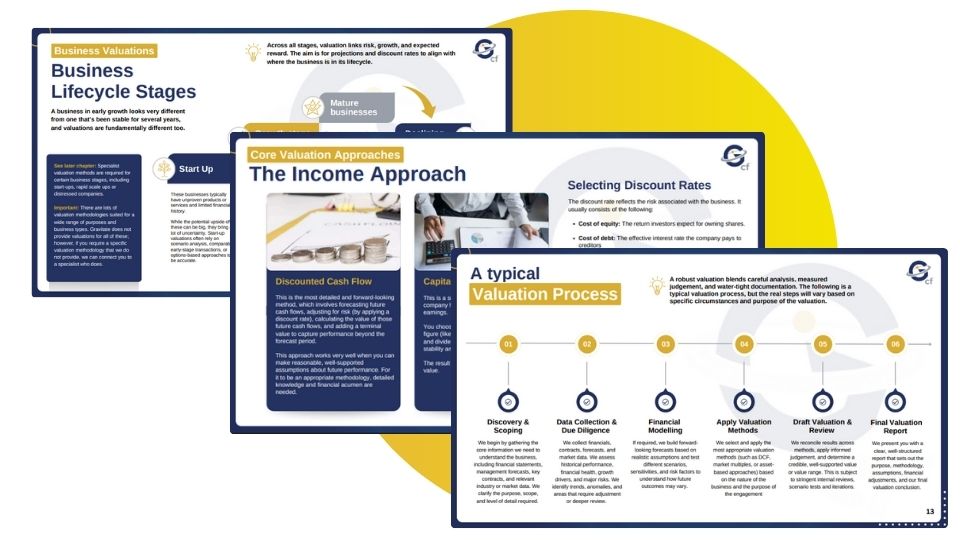
This is the most detailed and forward-looking method, which involves forecasting future cash flows, adjusting for risk (by applying a discount rate), calculating the value of those future cash flows, and adding a terminal value to capture performance beyond the forecast period.
This approach works very well when you can make reasonable, well-supported assumptions about future performance. For it to be an appropriate methodology, detailed knowledge and financial acumen are needed.
Capitalisation of Earnings
This is a simpler method, used when a company has steady and predictable earnings.
You choose a representative earnings figure (like an average or adjusted number) and divide it by a rate that reflects business stability and expected return.
The result is a single, easy-to-interpret value.
Selecting Discount Rates
The discount rate reflects the risk associated with the business. It usually consists of the following:
- Cost of equity: The return investors expect for owning shares.
- Cost of debt: The effective interest rate the company pays to creditors
- Weighted Average Cost of Capital (WACC): This is a blend of equity and debt costs, which is adjusted based on how the business is financed.
The general rule is the higher the risk, the higher the discount rate, and the lower the valuation. This ensures the valuation properly accounts for uncertainty.
What is the Market Approach to Valuations?
The Market Approach to valuations looks to determine the value of business based on how similar businesses are priced in the real world.
Guideline Public Company Method
The guideline public company method compares the business to publicly traded companies within the same industry. A valuer will look at the revenue, EBITDA, EBIT or Net Earnings of these companies and apply them to yours for the purposes of valuation.
EBITDA: Earnings Before Interest, Taxes, Depreciation, and Amortisation.
Public companies provide transparent data, so this can be a reliable benchmark.
Guideline Transactions Method
For the guideline transactions method, the comparison comes from what was paid in recent comparable private company sales.
These transactions are a good indication of what real buyers have been willing to pay for similar businesses.
What is the Asset Approach to Valuations?
The Asset Approach to valuations estimates the company value based on the “fair market value” of its assets minus its liabilities. Instead of focusing on earnings or market comparisons, it looks at what the business would be worth if its parts were valued individually.
This approach is commonly used for property or capital-intensive businesses, as well as holding companies.
Looking for more information on valuations?
This blog features an excerpt of our recently published guide to Business Valuations. Our commitment is to share knowledge about the most important aspects of big business decisions, including major transactions. If you'd like to know more about valuations, we encourage you to download your copy of our guide today.















.webp)
.png)


.svg)
