
.webp)
.png)

Many business owners assume a Finance Director is only for large, established businesses with massive turnover and complex financial affairs, but this isn’t always the case.
Most businesses on a growth trajectory will reach a point where good bookkeeping and standard compliance (statutory accounts, tax returns, etc.) are no longer sufficient. So where does that additional resource come from?
In this blog, we’ll outline the key signs that your business may be ready for a Finance Director, and how to approach the decision.
What does a Finance Director actually do?
A finance director (or FD) takes on a critical role in business. They are a senior leader within your business, responsible for managing and ensuring your company’s financial health and profitability.
They play a key role in shaping business strategy, growth plans, and budgets, and ultimately ensure company leadership can make the right financial decisions.
Where applicable, an FD will undertake cash flow forecasting and profitability analysis. They will also handle your finance function, from budgets and financial reporting, all the way up to strategic planning and risk management.
What jobs can be done by a Finance Director?
When do you NOT need a Finance Director?
Put simply, you do not need a Finance Director at every stage of your business journey. Despite an FD being a hugely valuable asset for companies that are ready, their expertise is simply not required for everyone. Here are some signs that suggest your business doesn’t need one just yet.
Your business is in an early stage of growth
- Revenue is at the lower end of the SME scale (for example, less than £3million)
- Founder/owner likes to be heavily involved in every decision
- The finances of the company are relatively simple
- There aren’t many employees
Your business isn't changing
- Revenue is stable
- Margins are consistently healthy
- There aren’t any major investment plans incoming
- Borrowing isn’t in the plan
- There are no plans to expand or diversify operations
You’re only looking for compliance support
If you are principally interested in remaining compliant, you may just need the fundamentals taken care of, such as your statutory accounts, corporation tax, payroll and VAT returns. You do not need an FD to do any of this.
What are the signs you need a Finance Director?
When your business is ready for a Finance Director (or equivalent support), the signs will be there, as your business will begin to outgrow your incumbent accounting arrangements and finance function.
Ideally, none of these signs should sneak up on you. You should have a fair understanding of what the future will look like, even without an FD. This is one of the reasons we recommend an accounting advisory approach to clients.
What turnover level means a Finance Director might be needed?
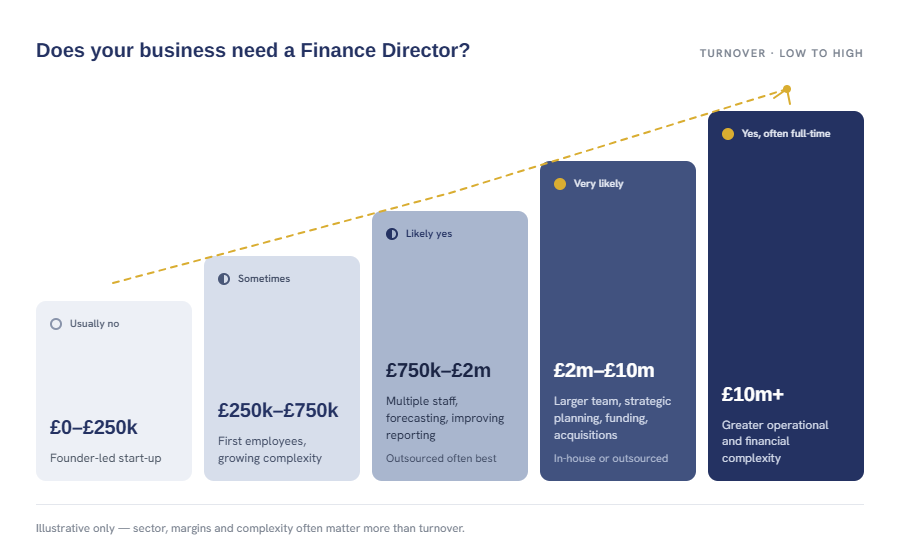
Below is a table which provides a basic, illustrative example of when a business may benefit from FD-level expertise, and when they may not.
Important: There is no universal rule here, and this should not be used to make major decisions without proper advice. The reality is things like your sector, margins, funding requirements and business complexity often matter more than turnover.
When to hire an FD and when to outsource?
Hiring a Finance Director doesn’t necessarily mean a full-time hire. For such a high-level employee with sufficient experience and knowledge, you may be looking at a six-figure salary commitment, possible equity options and, of course, recruitment fees and payroll taxes on top of that.
This is often what makes growing businesses reluctant to invest in the skills that a Finance Director brings.
An Outsourced Finance Director gives you an alternative option, with lower-cost commitments, greater flexibility, and a wealth of industry experience.
When might an Outsourced FD be better than in-house?
An outsourced FD might be a more suitable option than hiring in-house for a number of reasons; however, these are just general examples. There are no set rules here, and the right answer will always depend on the specific business and its owner’s goals.
We often find that the outsourcing option is best suited to growing SMEs or Owner-Managed Businesses who want strategic advice to support their growth and decision-making, just not every day!
What does a Finance Director cost?
According to research from within the recruitment industry, the average salary of a Finance Director in the UK can start from £100,000 to £120,000 a year for SMEs and mid-market companies. For larger corporations, this gets significantly higher. This will also vary by location, with London often being considerably more expensive.
It’s also worth noting that most Finance Director packages are likely to include benefits beyond base pay, as well as potential equity options. It is usually one of the highest-paid leadership positions within the business, making it a significant long-term investment.
What does an Outsourced Finance Director cost?
As providers of Outsourced FD services to clients, we can only comment on what our services cost (you can see it all on our pricing page).
- At Gravitate, an Outsourced Finance Director costs approx. £950+VAT per full day. The full cost therefore depends on how often you want the service.
- As an alternative, we also provide outsourced Financial Controller (FC) services at a cost of approx. £570+VAT per day. Again, this enables flexibility of overall pricing based on that.
These numbers should hopefully give you an idea of what to expect when exploring these options.
Start with a conversation
If you’re reading this, you’re already thinking about a Finance Director and what they can bring to your business, which is a great sign that you’re focusing on long-term growth, sustainability and financial health.
Getting this decision right could be the difference between success and failure in the years to come, so we strongly recommend discussing your situation and goals with an expert. Our team is happy to help with this – even if the best choice for you isn’t to work with us. Contact us today if you’d like to learn more.















.webp)
.png)


.svg)
