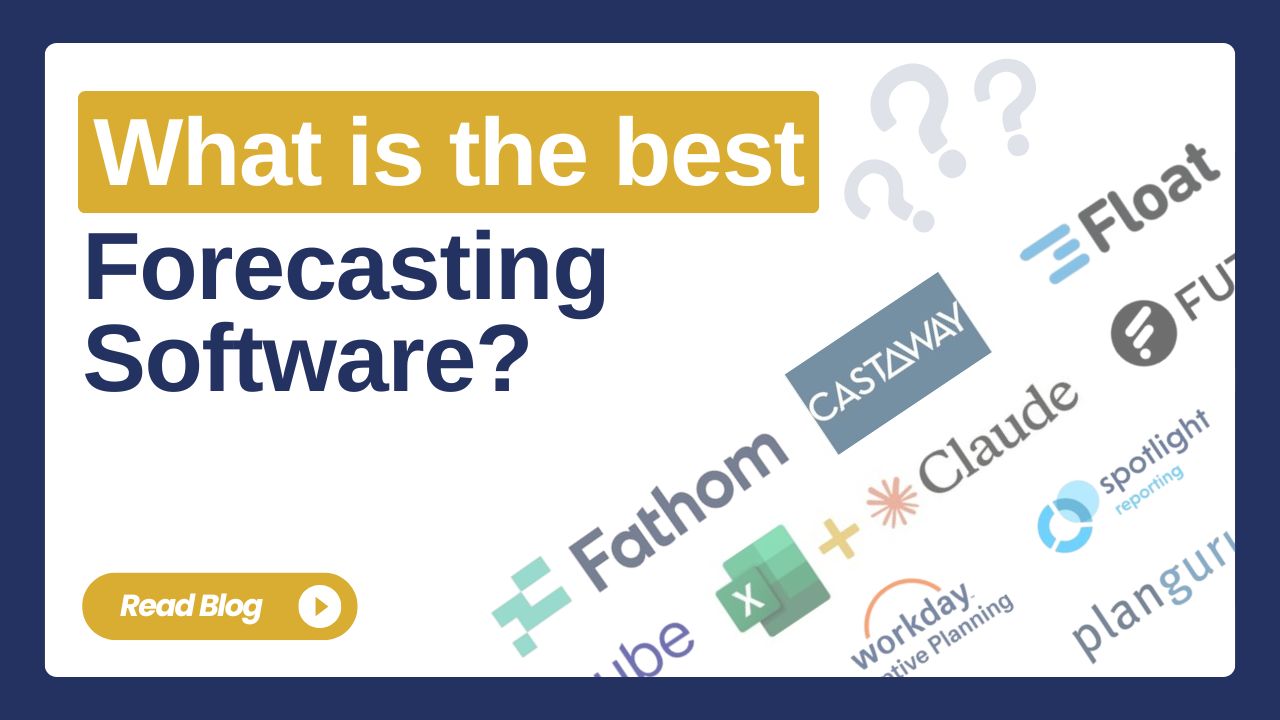
Modern tools like Fathom and Castaway integrate the P&L, balance sheet, and cash flow into a single connected model to ensure data accuracy and reliability.
Integrating Claude AI directly into Excel workflows enables businesses to automate data analysis, debug complex formulas, and build financial models significantly faster.
Options range from Float for simple real-time cash visibility to Workday Adaptive Planning for enterprise-level scaling and cross-departmental collaboration.
Updated:
April 21, 2026
The best software for budgeting and forecasting depends upon your role and priorities; the good news is there is almost certainly a great piece of software available that can help ensure your budgets and forecasts are accurate, dependable, and not a time-sink!
If you’re reading this, then you’re already looking to go beyond a basic spreadsheet and aiming to improve the quality of your forecasts.
This is great news, because a KPMG survey revealed that over two thirds of companies credit accurate forecasting with identifying growth opportunities.
Fathom
Fathom is an excellent tool for cash flow forecasting and is one that we use at Gravitate to provide our clients with forecasts they can rely upon.
Its integrated three-way forecasting capabilities combine profit and loss, balance sheet and cash flow into a single, connected model, giving a more complete and accurate financial picture than standalone cash tools.
Strengths
Limitations
Integrated three-way forecasting (P&L, balance sheet, and cash)
May lack advanced modelling functionality
Automated data syncing from accounting systems
Potentially steep learning curve
Scenario planning for strategic decision-making and stress testing
May lack broader enterprise-level integrations
Attractive dashboards and data-viz
No permanent free plan available
User-friendly interface
Less suitable for very small startups seeking low-cost options
Castaway
Castaway is a dedicated financial forecasting and budgeting tool designed for accountants and advisers who require detailed, flexible forecasting models and deeper financial analysis.
It is another platform we use at Gravitate when clients need more advanced, highly customised financial modelling.
Castaway enables robust three-way forecasting, long-term scenario planning and in-depth sensitivity analysis, making it particularly valuable for strategic planning, funding discussions and complex business structures.
Strengths
Limitations
Dedicated platform with detailed customisation
Primarily desktop-based
Advanced three-way forecasting with high modelling flexibility
No automatic live data syncing
Strong scenario planning and version comparison tools
Steeper learning curve for non-finance users
Detailed budgeting, cash flow forecasting, and KPI tracking
May be more complex than necessary for simple businesses
Suitable for complex businesses
Excel (Integrated with Claude AI)
Claude AI now has a direct integration with Microsoft Excel that lets you use the AI inside your spreadsheet workflow rather than just in a separate chat window. This significantly enhances how you can work with models and data in Excel. We have also begun using Claude’s Excel integration to assist our clients.
Strengths
Limitations
Built directly into Excel via add-in
Not a dedicated forecasting or FP&A (Financial Planning and Analysis) platform
Can analyse spreadsheets, explain complex formulas, and debug errors
Requires paid Claude plans
Assists with building and extending financial models
Dependent on Excel structure
Supports scenario modelling and “what-if” analysis
Not purpose-built for multi-entity consolidation
Context-aware editing
May not replace specialist financial modelling expertise
Reduces time spent on manual work
Features and capabilities may change suddenly
Additional Softwares
The following tools are not ones that we use ourselves to provide forecasting and financial models for clients; however, they can provide some considerable benefits for those who use them.
The tools listed here are based on current market visibility, common industry usage, and publicly available information at the time of writing.
Inclusion does not represent endorsement, partnership, or recommendation unless explicitly stated.
Gravitate does not currently use the following tools. To provide a balanced description of each platform’s pros and cons, we have collated feedback published by other users and reviewers and cited each instance.
Float
Float is another cloud-based cash flow forecasting tool that integrates with accounting platforms like Xero, QuickBooks and FreeAgent to give real-time visual cash flow forecasts and scenario planning tools.
Strengths
Limitations
Real-time cash flow forecasting with graphs and dashboards
May struggle with forecasting for highly seasonal businesses because predictions are often derived from recent data or manual inputs rather than historical seasonal patterns.
Automatic syncing with cloud accounting data
Doesn’t include some advanced forecasting features
Easy scenario planning
Customisation of reports and cash flow scenarios have limited flexibility
Intuitive, user-friendly interface
Integration mainly supports popular accounting systems
Forecasts daily, weekly and monthly views, and can project up to ~3 years ahead
Futrli is a UK-available forecasting and reporting platform used by businesses and accountants to model cash flow, profits, budgets, and financial scenarios.
Strengths
Limitations
Real-time cash flow, P&L and balance sheet forecasting with scenario modelling and reporting
Pricing can be relatively high for smaller businesses or sole traders
Automatic syncing with cloud accounting software
Can be complex to set up and configure
Intuitive dashboards and custom reporting tools
Not as specialised for deep enterprise-level planning compared with full FP&A suites
Supports daily cash forecasting, KPI tracking and HR planning forecasts
Steep learning curve for users unfamiliar with forecasting tools
Can produce 3-year forecasts and scenario comparisons
May not suit those needing very long-term projections
Useful for accountants, advisers and SMEs looking for more than basic spreadsheet-based forecasting
Workday Adaptive Planning is a well-known enterprise performance management (EPM) tool designed for things like advanced budgeting, forecasting, and financial planning across complex organisations.
Strengths
Limitations
Powerful, scalable budgeting and forecasting with real-time data and advanced modelling capabilities
Implementation and initial setup can be time-consuming and complex
Cloud-based platform with collaboration across finance and operations
Some users report a notable learning curve with the interface and reporting tools.
Integrates with other enterprise systems (such as CRM, HR, etc.) across the business
A few reviewers have indicated that certain reporting features (e.g., formatting, audit trails, comment usability) are limited or not as polished as expected
AI-assisted forecasting and predictive features
Pricing is generally high and not necessarily transparent. Costs tailored by business need, which can make budgeting difficult for smaller organisations
Supports collaborative planning across financial and operational models
Strong cloud architecture with centralised planning
Spotlight Reporting is a forecasting and reporting platform designed for accountants, CFOs and business owners that combines financial reporting, budgeting, three-way forecasts, KPI dashboards and multi-entity consolidation.
Strengths
Limitations
Full reporting and forecasting with three-way forecasting and budgeting capabilities
Steep learning curve due to advanced features and flexibility
Strong multi-entity consolidation and group forecasting
Higher price point, which may be less suitable for smaller businesses
Highly customisable visual reports and dashboards for board-ready presentations
Less focused on short-term cash flow visibility
Integrates with major accounting systems like Xero and QuickBooks
Can be complex or finicky for users without forecasting/reporting experience
PlanGuru is a budgeting, forecasting and financial analytics platform that helps businesses and advisors create detailed, long-term financial plans, multi-year forecasts, and “what-if” scenarios for strategic decision-making.
Strengths
Limitations
Integrated three-way forecasting for up to 10 years of projections
Interface may feel dated compared to modern cloud tools
Multiple forecasting methods and scenario planning
Manual data import
Solid budgeting, financial ratios, cash flow projections and variance analysis
May be too complex for very small businesses
Integrates with QuickBooks, Xero and Excel to streamline data inputs
Advanced features may require learning time for non-finance users
Cube is an AI-enhanced financial planning & analysis (FP&A) platform that focuses on budgeting, forecasting, reporting and collaboration, with strong spreadsheet integration and AI-assisted modelling.
Strengths
Limitations
AI-enhanced FP&A that automates data consolidation and forecasting processes
Because Cube builds on spreadsheet workflows (Excel/Google Sheets), it may not suit teams looking for a fully standalone planning UI.
Seamless integration with Excel and Google Sheets
Not as deep in enterprise-wide planning features as the most comprehensive FP&A suites.
Supports driver-based planning and rolling forecasts
Some advanced visualisation or reporting capabilities may feel less polished than dedicated BI tools.
Provides collaborative planning and real-time version control
Intuitive dashboards and reporting
Helps bridge spreadsheets with automated workflows
Limitations collated from these sources: Reddit, G2.com
About this blog
The information we’ve presented in this blog is for general informational purposes only. Software features, pricing, availability, and integrations may change over time, so you should always verify details directly with the software provider before making any purchases.
Businesses should always make sure to assess their own needs, budget, technical requirements and access to expertise before choosing a forecasting or budgeting software.
Where appropriate, it’s always sensible to seek professional advice to ensure suitability.


.png)









.jpg)


.jpg)

%2010.jpg)










.webp)
.png)


.svg)
