

.png)
.webp)
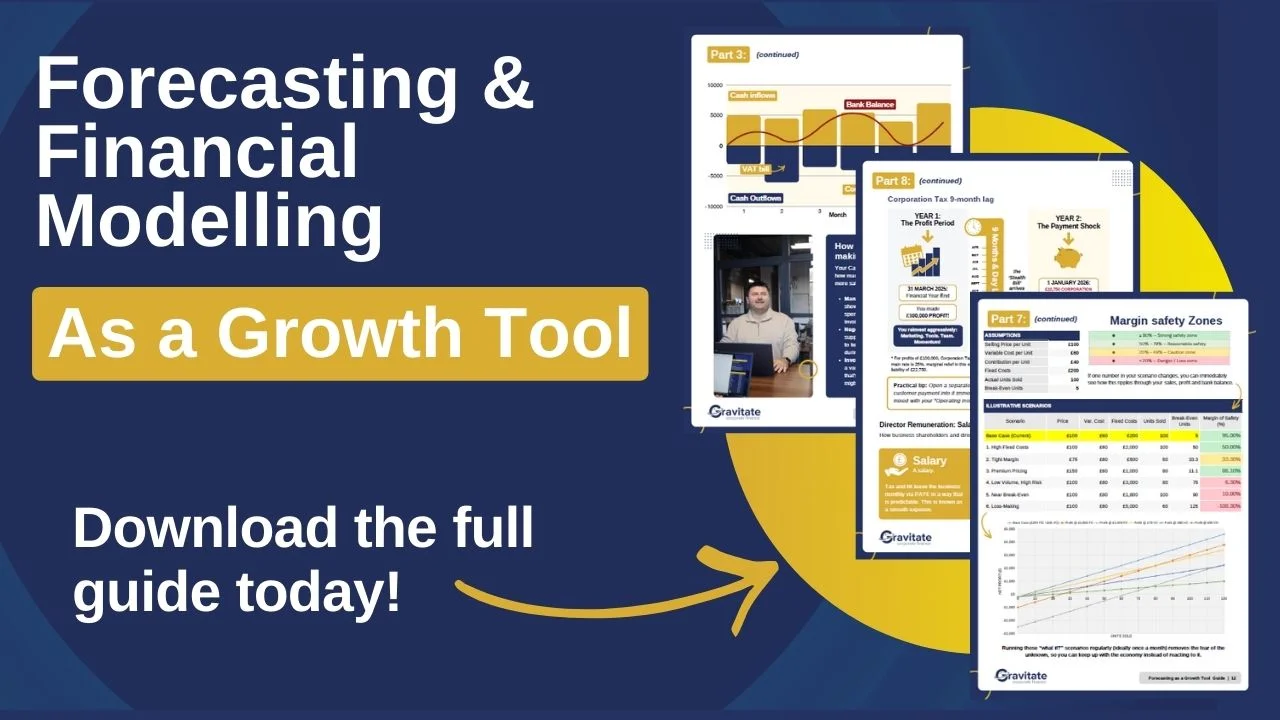
Financial Modelling is the process of using a company’s historical performance and data to produce a detailed spreadsheet – usually starting on Excel or Google Sheets – that can be used to inform future decision-making and analysis.
Typically project-based, it takes a more complex and forward-thinking approach than other types of financial projection.
Therefore, whether your business needs to utilise financial modelling depends on its complexity.
When do you need a financial model as well as a budget?
A simpler business may be best suited to a budget, rather than a financial model.
Financial modelling is growing increasingly essential because of how it helps businesses track financial habits, which can then be used to predict future events and ensure businesses are prepared for any investments or losses in the future.
Financial models are driven on assumptions, which allows for the evaluation of varying scenarios and asking questions like, “what if we increase turnover by 10%?”, “what if daylight saving hours decrease?”, “can we take on this large customer on 90-day terms”?
If you’re have a successful business thinking of branching out, you will likely need a financial model. So, it’s important to understand exactly how this can benefit your business!
What Does a Financial Model do?
A financial model helps translate assumptions into numbers. Acting as a decision-support tool, it tests “what if” scenarios such as price changes, cost increases and growth assumptions.
Its primary purposes include:
- Valuation: Estimating what a business or project is worth.
- Planning & Budgeting: Annual budgets, long-term strategic plans.
- Investment Decisions: M&A, Capital Expenditure, New Product Launches.
- Raising Capital: Supporting pitch decks for equity or debt financing.
- Performance Management: Comparing forecasts vs actual results.
At its core, financial modelling is a tool that provides a clear and structured representation of a company’s financial performance to ensures evaluation of outcomes before committing real money.
The Benefits of Financial Modelling
For a business, having forward projections in place has many benefits:
Helps Informed Decision Making
Financial Models enable businesses to make strategic decisions that are backed by data. This ensures a calculated approach to growth and development by forcing logical thinking and structured assumptions, which ultimately improves decision quality because you are making choices driven by data, not gut instinct.
Identifies Risks
Financial Models also help identify potential risks early by allowing businesses to develop mitigation strategies which protect financial stability.
Builds Confidence and Trust
Having a financial model in place also builds investor confidence and trust. Being able to provide a clear and transparent financial information is essential for gaining credibility which increases chances of funding because it attracts investments.
Financial modelling is both a technical and analytical skill which is widely applicable across industries. Understanding your numbers is massively beneficial for the future of your business, so it’s important to prioritise getting financial models in place to help your business grow!
If you seek advice on how financial modelling can help your business, contact us today.
Read More:















.webp)
.png)


.svg)
