

.png)
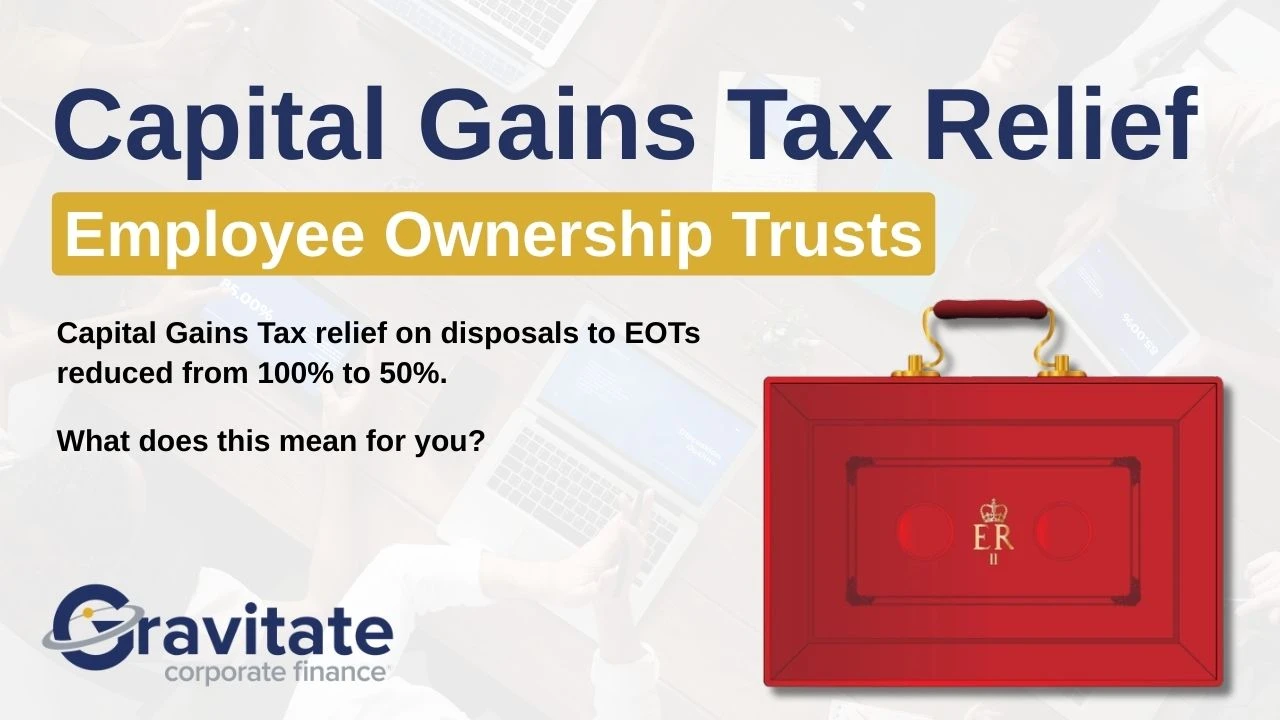
As someone who has helped many businesses transition successfully into EOT ownership, the Autumn Budget announcement was pretty seismic.
The Government has reduced Capital Gains Tax relief on disposals to EOTs from 100% to 50%, with immediate effect. This means an ‘effective’ Capital Gains Tax rate of c12% on all transactions, for most sellers, providing the rate of tax (24% for the higher rate in 2025/26) doesn’t change.
What does this mean for business owners considering an EOT?
Despite the headlines, EOTs remain a highly attractive succession route commercially, culturally, and fiscally. The effective tax rate of 12% is still one of the lowest rates of tax available across the board. But the landscape has obviously changed.
And it changed with immediate effect.
Below is a table of how this will look in practice
Our table assumes no cost for the business shares and the vendor being a higher rate taxpayer.
Despite CGT rates changing in April 2026, because EOTs do not qualify for Business Asset Disposal Relief, the effective tax rate should not change, based on current information.
Here’s what we recommend
- You may want to revisit your transition timeline if you were planning a sale in the near term based on an assumed 0% CGT charge.
- Financial models and funding structures should be reassessed to reflect the new 50% relief position.
- You may wish to re-evaluate whether to proceed now or to adjust their exit strategy – however, I strongly advise against any knee-jerk reactions!
- Exiting shareholders will now need to factor in a day one tax liability, so proactive tax advice is essential in the planning stages.
The core advantages of EOTs, including long-term founder legacy, employee engagement, business continuity, and tax-efficient structures, remain firmly intact.
There is no general impact on Business Asset Disposal Relief (BADR). The only change is that gains arising on shares sold to an EOT won’t currently qualify for BADR rates.


Employee Ownership Trusts: a comprehensive guide
Under the right conditions, the most tax-efficient way to sell your business, and the one route that protects your staff and your legacy too.
- How an EOT transaction is structured and funded
- The qualifying rules and four-year clawback period
- CGT relief, IHT exemption and tax-free staff bonuses
- The seven-step process, from valuation to governance
Reach out if you need advice
While this represents a major shift in the economic and tax implications of an EOT transaction, in many cases an EOT will still represent the most balanced and sustainable succession solution, even if it now requires more considered planning and guidance.
The effective tax rate of 12% is still a generous incentive that makes EOT a highly beneficial exit strategy for the right company and owners.
For any owners who are unsure how this affects their plans, send me a message and I’ll be happy to help you understand and explore the best path forward.













.webp)
.png)


.svg)
