

.png)

If you're sitting on a significant capital gain right now, such as a business you're planning to sell, a share portfolio, or a second property, there's one policy question that should be on your radar more than any other right now.
Andy Burnham became UK Prime Minister on 20 July 2026, with John Healey as his Chancellor. There is one tax legislation idea that has followed Burnham around for a very long time, and that is aligning Capital Gains Tax with Income Tax.
In other words, people paying CGT at the same rate as their respective Income Tax band.
This matters enormously for business owners, because it changes how much tax you'd pay on a gain, and because the window to plan around it is shorter than most people assume.
What does aligning CGT and Income Tax mean?
Burnham has spent the last several months making the case for what he's called “a wealth tax that works”. Specifically, aligning Capital Gains Tax rates with Income Tax bands.
In his own words:
“A pound made from simply owning assets should not be taxed less than a pound made from a hard day's work.”
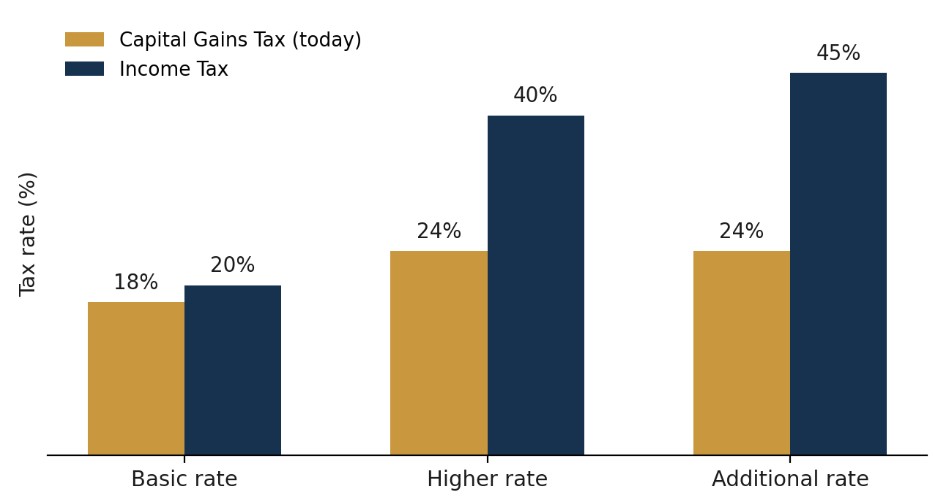
Today, Capital Gains Tax is charged at 18% for basic rate taxpayers and 24% for higher and additional rate taxpayers.
Income Tax, by contrast, runs at 20%, 40% and 45%. This is a big difference, and a key incentive for entrepreneurs and property owners to invest in activities that drive growth
Aligning the two would mean gains taxed at the same rates as a salary, therefore closing a gap that currently sits at 16 to 21 percentage points for higher earners.
In short – it means individuals selling assets could be taxed a lot more on their gains than they are currently.
The current Capital Gains Tax & Income Tax gap
A few points worth keeping in mind:
- This isn't law yet: This is a policy Burnham has backed repeatedly, but it is not a confirmed measure. This is all speculation until policy is officially confirmed.
- The revenue estimate moves: CenTax's modelling has been refined over time, and any estimate depends on assumptions about how people respond, e.g. whether asset sales are brought forward, delayed, or moved overseas.
How much would aligning CGT and IT raise?
CenTax (the Centre for the Analysis of Taxation) estimates that aligning Capital Gains Tax with Income Tax could raise up to £12bn a year, which is large enough to keep the idea in serious consideration for a long time. Given Keir Starmer’s Labour government ruled out raising Income Tax, National Insurance or VAT directly in their election manifesto, CGT is one of their only politically viable levers.
Is this policy supported?
What's particularly interesting about this policy is who is pushing back and, specifically, how objections are coming from different angles.
- The Centre for Policy Studies published a paper called Why Raising Capital Gains Tax Won't Work, arguing that taxing gains at up to 45% would deter entrepreneurship and investment, and risk costing the Treasury more than it raises.
- The Tony Blair Institute for Global Change published its own warning making a similar underlying point that aligning CGT with Income Tax may do more harm than good.
That’s two think tanks that agree on very little, but they are both warning the Prime Minister off his own signature tax idea within weeks of each other.
Why the timing matters
The Autumn Budget is expected in October or November as usual, and it will be Chancellor Healey's first one. It's also worth remembering that last year, policy detail was still being finalised right up to Budget Day itself.
This means there's often no reliable warning of exactly what's changing or when it takes effect, unless it is announced in advance.
If you’re planning a transaction
If you're looking at a transaction that would trigger Capital Gains Tax, like selling a business, crystallising gains on a portfolio or disposing of an investment property, these things take time to do properly.
From decision to completion, you could be looking at around three months once valuations, due diligence and legal work are factored in. Counting back three months from an October or November Budget puts the effective decision point now, over the summer.
That doesn’t mean it’s time to panic, but it does mean you should consider your position both now and if this policy is confirmed.

What should you be doing?
- Map out any significant unrealised gains: Knowing the size and timing of a potential gain is the starting point for any conversation before or after the Budget.
- Get an early valuation estimate: You don't need a formal process to start, but knowing roughly what a transaction might look like will tell you whether three months is realistic.
- Model both scenarios: Consider what your tax position looks like right now versus what it could look like if CGT rates do align with Income Tax.
- Seek advice before the autumn: Once the Budget date is confirmed, the window for planning narrows fast. Earlier conversations mean more options and wiggle room.
Common mistakes to avoid
Waiting for confirmation before planning
By the time a change is confirmed, the three-month runway to complete a transaction has usually already gone. Planning ahead of certainty is the whole point. This doesn’t mean committing to any major decisions immediately, but it’s important to think about your options sooner rather than later.
Rushing to sell purely to avoid a policy that might not happen
This is not a case for panic-selling an asset you weren't otherwise ready to part with. But it is important to understand your options well enough that, if the policy does land, you're not starting from scratch!
Assuming nothing will change because it's “only a proposal”
Burnham has backed this idea consistently, both in office and in opposition. It's now attached to a sitting Prime Minister rather than a backbench campaign. All in all, that's a different level of risk than it was a year ago.
Getting this right is important
None of this is a reason to panic, but it is a reason to get the full picture in front of your adviser now, while there's still time to plan properly rather than react.
How we can help
If you're sitting on a significant unrealised gain and want to understand what alignment of Capital Gains Tax and Income Tax would mean for you specifically, get in touch and we can start having those conversations. We can talk through the numbers, the timing, and whether bringing a decision forward makes sense for your circumstances.
This article is provided for general information only and does not constitute personal financial, tax or investment advice. Tax rules and rates depend on individual circumstances and may change. Please speak to a professional adviser before making any decisions.


.jpg)


.jpg)

%2010.jpg)









.webp)
.png)


.svg)
