
.webp)
.png)

When you started your business, financial management may have been quite simple. You may have tracked invoices on a spreadsheet, kept costs low, and managed cash flow by feel. For a while, it worked.
Then there’s the stage where you bring in an accountant to assist with your reporting obligations and tax returns with the help of accounting software.
But there comes a point in every company’s journey when the fundamentals of accounting are no longer enough. You don’t just need to know what you spent; you need to know what it means for your future. That’s where Management Accounts come in.
Unlike annual statutory accounts that look backwards (where you were 9-12 months ago) and are simply for tax authorities (HMRC, Companies House), management accounts are for you. They help you to look ahead, focusing on how your business is performing, where it's succeeding, and where it is struggling.
They’re able to transform your financial data into actionable insights that enable informed decision making. But what are they and when do you actually need them?
What are management accounts?
Management accounts are internal financial reports prepared regularly to help business leaders plan, control, and make decisions about the business. Usually prepared either monthly or quarterly, they provide clear insight into the financial trading position of your business. They’re intended for directors and decision makers of the business and are not filed with HMRC.
According to industry research, SMEs that use management accounts to inform their decisions grow about 28% faster than their market peers.
All businesses generate data; the challenge is extracting meaningful information from a sea of numbers. Management Accounts cut through the noise and put the key information front and centre.
Management accounts are tailored specifically to your business model and its goals, which turns them from passive reports into powerful strategic tools.
Why do you need Management Accounts?
To successfully grow your business, you need to be able to monitor your finances and measure performance throughout the year, not just after each year-end. If there’s an emerging problem in your finances, the year-end may be too late to take proactive action.
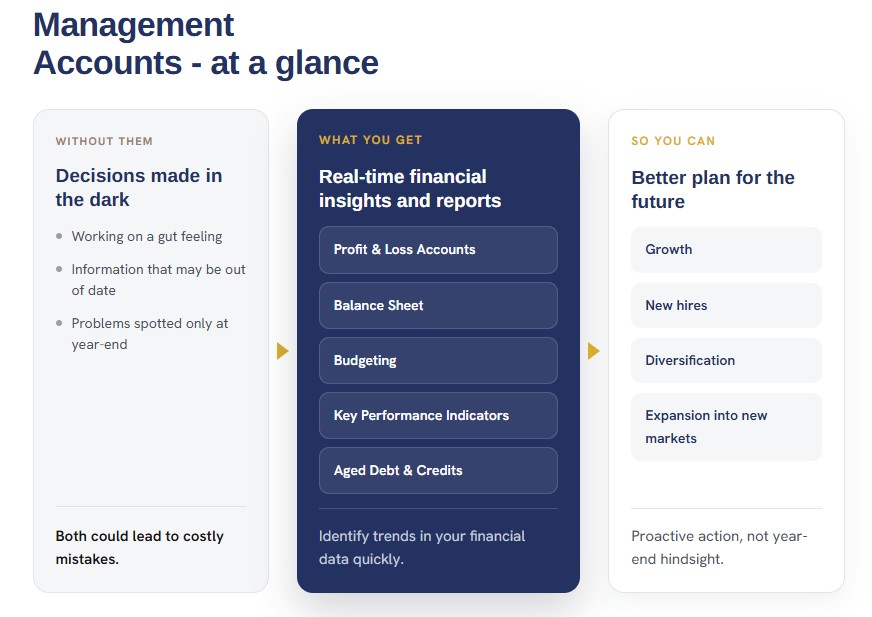
Management accounts will set you up with real-time financial insights and reports, including:
- Profit & Loss Accounts
- Balance Sheet
- Budgeting
- Key Performance Indicators
- Aged Debt & Credits
When you can identify trends in your financial data quickly, you can better plan for the future, whether that is growth, new hires, diversification, or expansion into new markets.
Without it, you’re either working on a gut feeling or information that may be out of date; both could lead to costly mistakes.
Additional benefits of management accounts:
- Improved confidence in financial decision-making.
- The ability to measure the performance of your business, teams, and individuals against your most important targets.
- They can work as a basis for appropriate, commercially relevant KPIs.
- Greater understanding of where money is being spent, without having to trawl through invoices and historical reports.
Who management accounts are for
There is no set criteria for whether management accounts are required, but below are some examples to illustrate the type of business that typically benefits most.
Growing businesses
Management accounts are ideal for businesses experiencing rapid growth. This includes businesses where revenue is rising, but team size, inventory, and overheads are scaling even faster. In such cases, it’s more important than ever that business owners have full knowledge of and trust in their financial figures. If you’re a company seeking funding or loans, relying on 14-month-old tax filings won’t be enough for banks and investors.
Complex businesses
Management Accounts are also well suited to complex business models, such as some subscription and SaaS businesses, multi-product e-commerce companies, or service firms tracking project-based profitability.
If you seek more control over your business, management accounts provide the financial information you need to make strategic decisions and move your company forward.
Who they are not for (yet)
Despite how valuable management accounts can be, there are circumstances where this might not be the case. If any of the following apply to you, Management Accounts may not be as beneficial (yet):
- Early-stage solo founder or micro-business: If your operations are simple and turnover is modest, standard bookkeeping and accounting is plenty.
- Simple business model and finances: A single serve freelancer with minimal overheads doesn't need monthly variance analysis..
- Anyone who won't actually read them: Management accounts only add value if leadership uses them to make operational decisions. Even a complex, rapidly growing business that is a prime candidate for management accounts in principle will not benefit from them if they aren't used properly.
Signs you need management accounts urgently
Management accounts are often selected as a regular strategic tool to be provided by your accountant or finance team, but there are also instances where management accounts might be able to resolve an urgent requirement on a one-off basis. These include:
- Surprise tax bills: realising you owe significantly more VAT or corporation tax than saved.
- Margin erosion: revenue is rising, but net profit percentage is quietly shrinking.
- No insight into product/service profitability: not knowing which client or offering makes money vs drains resources.
- Slow decision-making: delaying hires, campaigns, or inventory purchases out of fear or guesswork.
If your goals are growth, but you are only preparing the annual statutory accounts, you’re missing out on critical insights for planning and decision making.
Management accounts don’t just show where you are now; they show where you’re heading, helping you decide what to do next.
When working on management accounts, businesses should also consider Cash Flow Forecasts as additional reporting, particularly for those that are cash-poor or going through cash-intensive periods in their business life cycle.
If you’re struggling to fully understand your financial performance but need assistance with rapid growth, complex business models, or obtaining funding and loans, get in touch.














.webp)
.png)


.svg)
