

.png)
Two companies can look almost identical from the outside but face very different tax outcomes at the point of sale, or on the death of the owner. The reason usually comes down to a single question: is it a trading company or an investment company?
This distinction is really important but frequently misunderstood, often at significant cost.
This is because the label that HMRC attaches to your company affects how much tax you pay each year, as well as what happens when you sell your shares, and finally, what your estate looks like after you are gone.
What is a trading company?
A trading company is a company that earns its income from commercial activities, such as sales. Technically speaking, its defining feature is active, commercially driven work being done in pursuit of profit and whose activities do not include to a substantial extent, activities other than trading activities. This covers most operating businesses, such as marketing agencies, SaaS companies, or manufacturers.
How is an investment company different from a trading company?
An investment company does not earn its income from active commerce. Instead, it earns income from holding assets instead of working them for profit.
HMRC often uses the phrase "company with investment business" when talking about investment companies.
In other words, a company whose income comes from letting property or holding cash on deposit would be an investment company, because it is not engaged in any commercial sense. It owns things, and those things generate a return.
Why does this matter?
The UK tax system is generally quite generous to genuine trading activity. It is considerably less generous to passive wealth held inside a company.
How does HMRC tell them apart?
HMRC will distinguish trading companies from investment companies by considering overall activities. It will assess where income comes from, what the assets look like, how people spend their time, and where profits are generated.
Here’s the technical (but very important) bit
For most of the reliefs discussed below, the working test is whether the company is trading "wholly or mainly". HMRC interprets "mainly" as roughly 80%, so a company that is 90% a trade, with a small amount of surplus cash invested on the side, will usually still qualify. Below that threshold, the position becomes genuinely uncertain and professional advice is needed.
The grey area is where problems tend to hide. A trading company that sells its assets, banks the proceeds and sits on a large cash pile which is then invested to generate passive income, can tip over into non-trading status at a point in time. A family firm that gradually shifts toward either leasing out its old premises or reinvesting in rental property can do the same. These transitions rarely happen on a clear date, which is precisely why they catch people out.
Tax difference 1: Corporation Tax
Since April 2023, corporation tax operates in three bands.
- Companies with profits up to £50,000 pay the small profits rate of 19%
- Companies with profits over £250,000 pay the main rate of 25%
- Those in between pay 26.5% on profits within the band, with Marginal Relief tapering between the two.
Both thresholds are divided between associated companies, so groups need to be aware of the implications.
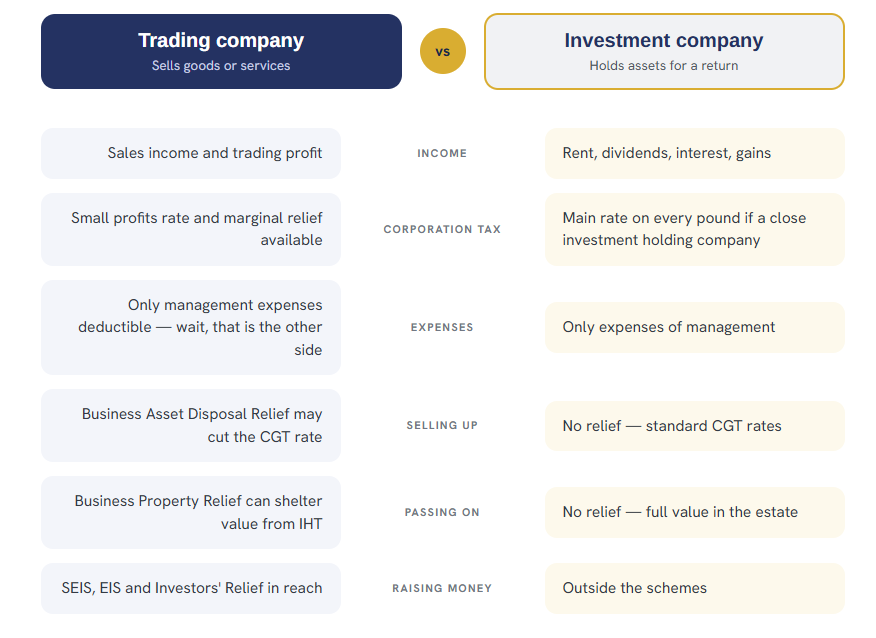
This applies equally to trading and investment companies. As you can see, Corporation Tax is not where the biggest difference lies.
Tax difference 2: Selling the company
This is where the difference becomes much bigger.
Business Asset Disposal Relief (BADR) means a qualifying individual can pay a reduced Capital Gains Tax rate on the sale of shares, up to a £1 million lifetime limit.
The rate has been gradually increasing. It was 10% until 5 April 2025, rose to 14% for 2025/26, and is 18% for disposals from 6 April 2026. Even at 18%, that is meaningfully below the standard CGT rates on gains of this size, and on a substantial sale, the saving is significant.
Qualifying for BADR
To qualify for Business Asset Disposal Relief (BADR), the company’s main activities must be trading. In other words, if you sell shares in a trading company, you can claim BADR. If you sell shares in an investment company, you can’t - the gain will be taxed at the standard rates.
Tax difference 3: Succession
When a shareholder dies, the value of their company shares forms part of their estate for Inheritance Tax (IHT), which is generally charged at 40% above the available allowances.
Business Relief can reduce that value by up to 100% for shares in an unquoted trading company, subject to the threshold of Business Relief. That’s a very powerful succession tool. However, this specifically excludes companies that consist "wholly or mainly" of making or holding investments, dealing in securities, or holding land and buildings as investments. In other words, investment companies are out of luck.
Some important points
- From 6 April 2026, Business Relief has been reformed so that the 100% rate is broadly capped at a combined £2.5 million allowance for qualifying business and agricultural property, with relief above that level reduced to 50%. Even qualifying trading businesses now need to plan more carefully than before as previously, Business Relief at 100% was not capped.
- For investment companies, shares will attract no Business Relief at all, leaving those assets subject to the 40% charge. To make matters worse, shareholders often need to extract dividends from those investment companies to generate cash to settle the Inheritance Tax liability, thereby triggering further income tax.
If estate planning matters to you, the classification of your company needs to be at the top of your priority list!
Tax difference 4: Day-to-day position of the company
There are some other reliefs which are solely for active trading companies:
- R&D tax credits are the obvious example. An investment company simply will not be carrying on the kind of activity they reward, and the treatment of capital allowances and trading losses also differs between the two.
- Letting out a property for rent is an investment activity. Buying, developing and selling property is trading. Two property companies can therefore sit on opposite sides of the line, and a company doing a mixture of both requires careful analysis.
- A change in intentions between letting and developing can also carry VAT implications, so property always calls for wider, longer-term advice.
Why this matters to you
Most founders do not set out to run an investment company; they build a trading business.
However, over time, they accumulate property, cash and other assets inside it. That accumulation of assets is exactly what can shift you from trading status to investment (and therefore cost you BADR, etc).
The good news is this can all be planned for effectively with the right advice.
- Surplus cash can be managed
- Investment assets can be structured effectively
- The timing of a sale can be aligned with the company's trading status
The golden rule here is to allow yourself time. These changes take time to implement properly, and relief can be list if action comes too late.
If you are unsure which side of the line your company sits on, or you are thinking about an exit or succession, it is worth getting a clear read on your position sooner rather than later. Contact us today if you need advice on this topic.









.webp)
.png)


.svg)
